
Douglas County Arrest Warrants Explained
Douglas County arrest warrants trace back to two statutes. NRS 171.106 lets a magistrate issue one when a sworn affidavit shows probable cause that a triable offense happened in the county and that the defendant committed it. A prosecutor can ask for a summons instead in the right case. NRS 171.108 spells out what the warrant must contain: the named person or a description, the date and place it issued, the offense, an order to arrest the person and bring them before a magistrate, and any no-knock authorization. Those rules build the instrument. They do not create a public name search. They also cannot tell you whether an old entry on a Douglas County record is still active.
How a Douglas County Arrest Warrant Is Issued
A judge issues a Douglas County arrest warrant. A peace officer then executes it, and the underlying case may sit in District Court, East Fork, Tahoe, or another jurisdiction. The paperwork names the court, case number, and offense. Ask that court's clerk for current status instead of assuming DCSO holds the complete case file.
- Identify the named court and case number.
- Use the court’s case-access or records procedure.
- Ask the clerk whether a warrant entry is current.
- Use DCSO dispatch for execution or custody routing, not as a replacement for the clerk.
- Confirm the final disposition after any court action.
What a Douglas County Arrest Warrant Contains
The statutory elements help you read a Douglas County warrant without treating a sample as your own record. NRS Chapter 171 supplies the structure. The details come from the actual document. Access can still be limited by sealing, restricted records, juvenile or family rules, or the court's local procedure.
| Person or description | Identifies whom the command concerns, subject to the actual court document. |
|---|---|
| Offense | States the offense basis described in the warrant. |
| Issue date and place | Helps separate an old document from later court events. |
| Command | Directs arrest and bringing the person before a magistrate. |
| Execution detail | Ask the court or authorized official about current status; do not infer it from a news story. |
Nevada Law Separates Arrest and Search Warrants
Search warrants live in a different part of the law, NRS Chapter 179, which covers probable cause, the place or property to be searched, execution, inventory, receipt, return, and sealing. That distinction matters when you read sheriff news. The Douglas County Sheriff's Office may report a search-warrant operation while publishing no searchable roster of arrest warrants. Fugitive and extradition matters run on separate tracks too. A public notice could involve a warrant issued elsewhere or an interstate process. Before assuming a Douglas County case, confirm the originating jurisdiction. The official NRS Chapter 171 text holds the statutory source for how arrest warrants are issued and what they must contain.
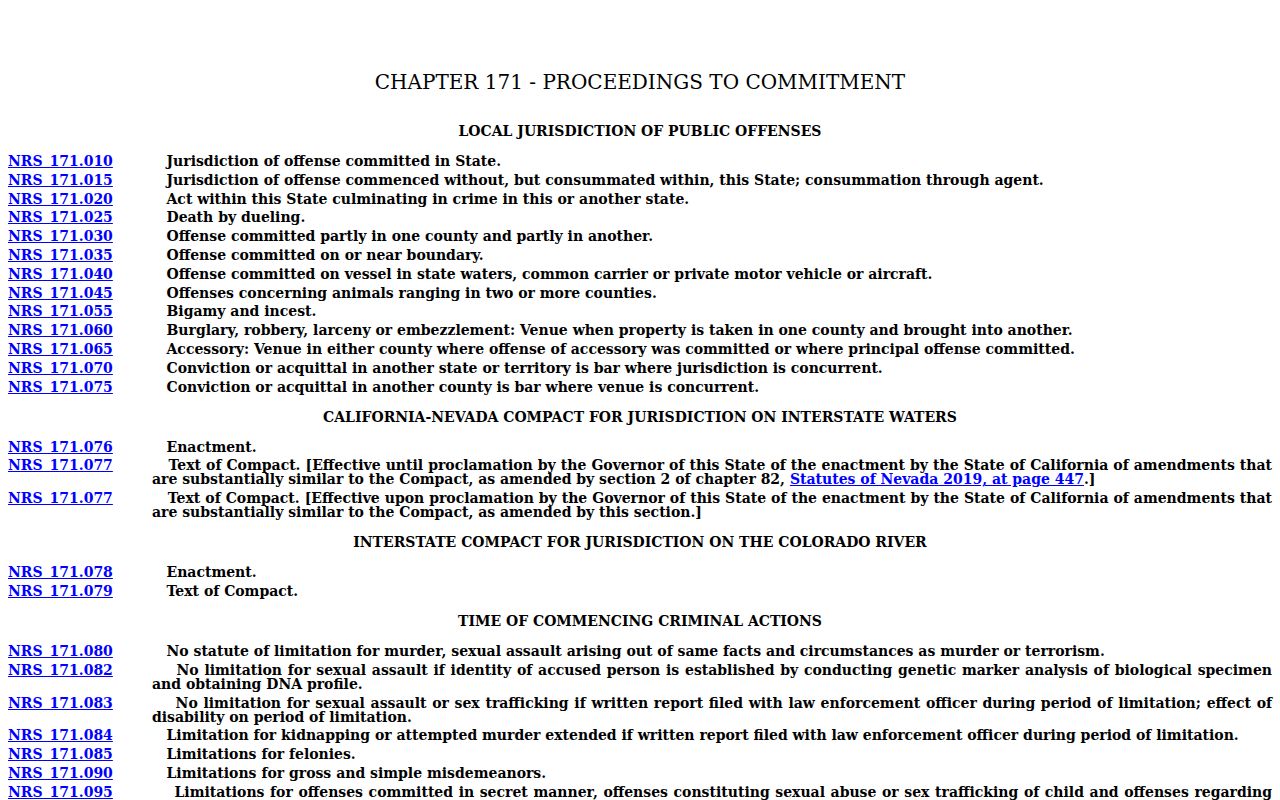
The screenshot is statute context, not a person-level record.
Arrest Warrant vs Summons vs Bench Warrant
Three terms get used loosely. An arrest warrant commands an officer to arrest a person and bring them before a magistrate. A summons just orders an appearance. In Douglas County, a bench warrant usually follows a missed court date or a failure to comply, so the triggering event and the court process matter more than the label.
| Instrument | Central question | First route |
|---|---|---|
| Arrest warrant | Was probable cause found for an offense? | Issuing court |
| Summons | Was appearance ordered without an arrest command? | Court notice and clerk |
| Bench warrant | Was a required appearance or order missed? | Court that set the event |
How DCSO Serves and Routes Douglas County Warrants
DCSO calls itself Douglas County's only local law-enforcement agency. Dispatch and the non-emergency line are (775) 782-5126, Records is (775) 782-9933, and the Valley facility sits at 1038 Buckeye Road in Minden. Those contacts work for questions about execution, custody, or a releasable report. The Sheriff site is not a judicial-status database.
Douglas County Sheriff’s Office
Valley office: 1038 Buckeye Road, Minden
Dispatch (775) 782-5126
What to Do If an Arrest Warrant May Exist
Talk to a lawyer or the issuing court first. Ask whether the court wants a motion, a hearing, an appearance, bond, or some other condition. There is no universal surrender rule in Douglas County; the right step depends on the court and the case. For custody matters, use the official jail route. Verify bail there and ask the court about the underlying status.
Do not guess: independently verify the court number and never pay an unsolicited caller with gift cards or cryptocurrency.
Access Limits on Douglas County Arrest Records
NRS Chapter 239 backs access to Douglas County government records, with statutory exceptions and redaction. Court records follow court rules instead. The District portal says sealed, confidential, and restricted information stays off the public display. It also warns the data may not be current.
Use the proper custodian: ask the court for a judicial warrant or docket record, DCSO for a releasable law-enforcement record, and the jail for current bail information.
Nevada Public Records Law and the county request page explain access limits and response choices.
Cross-Jurisdiction Arrest Warrant Questions
No Douglas County source can confirm another county's warrant. Another Nevada county, another state, a federal court, or an extradition process each keep their own records. PACER handles federal cases, not a national warrant list. A DCSO news item can mention a fugitive or an outside warrant without covering every Douglas County record. Find the originating court or agency first. Then use its own records and contact route. That keeps an absence in Douglas County sources from being mistaken for an answer about another jurisdiction.
Confirm the Douglas County Arrest-Warrant Result
After a payment, bond, appearance, motion, or surrender, ask the issuing court what happened to the warrant. It may have been recalled, quashed, stayed, served, or otherwise resolved. Ask for written confirmation too. A blank jail display proves nothing. An old docket line does not either. The Douglas County warrant lookup route explains how to identify the right court and records channel, so bring a date, a case number, and a named clerk whenever you can.